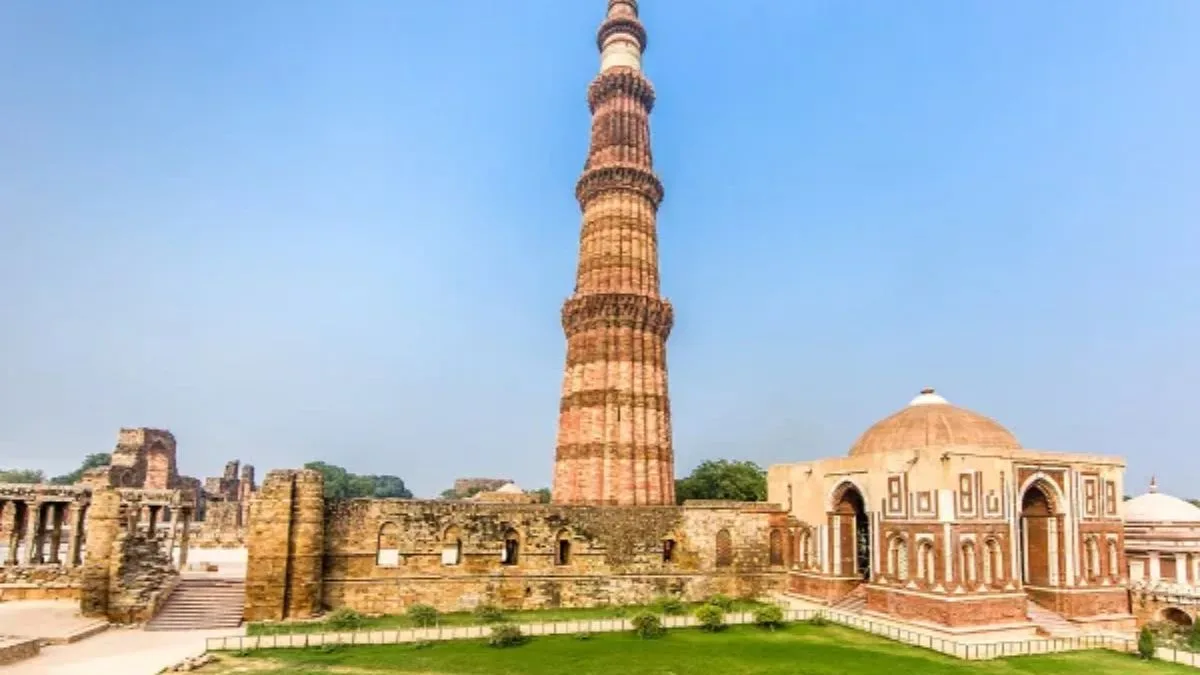
Delhi, the capital of India, not only serves as the nation’s seat of power but also reflects the grandeur of its past empires. The city is home to three UNESCO World Heritage Sites — the Qutub Minar, the Red Fort, and Humayun’s Tomb. These monuments stand as enduring symbols of India’s rich cultural and architectural legacy and remain major tourist attractions.
According to the latest report from the Archaeological Survey of India (ASI) for the fiscal year 2024–25, Delhi’s heritage sites collectively attracted a record 7.9 million tourists. The Qutub Minar recorded the highest footfall with 3,439,575 visitors, while the Red Fort and Humayun’s Tomb ranked second and third with 2,963,710 and 1,163,649 visitors respectively.
Advertisement
Among Delhi’s 11 protected monuments, other notable sites such as Jantar Mantar, Safdarjung’s Tomb, Hauz Khas Complex, Old Fort, Firoz Shah Kotla Fort, Tughlaqabad Fort, Khan-e-Khana Tomb, and Sultan Ghari Tomb also attracted thousands of visitors. In total, 7,950,048 tourists visited these monuments during 2024–25, highlighting Delhi’s enduring appeal as a hub of historical tourism.
At the national level, the ASI report places the Taj Mahal in Agra at the top of India’s most-visited heritage sites, welcoming 6,969,665 tourists. It is followed by the Sun Temple in Konark, Odisha (3,576,348 visitors), while Delhi’s Qutub Minar and Red Fort occupy the third and fourth positions respectively.
The Agra Fort ranks fifth, drawing 1,786,883 visitors, followed by the Ellora Caves in Maharashtra (1,760,583), Golconda Fort in Telangana (1,579,483), Aguada Fort in Goa (1,371,815), Charminar in Telangana (1,353,065), and the Udayagiri and Khandagiri Caves in Odisha (1,242,595).
The ASI has made significant strides in enhancing the visitor experience at Delhi’s historical sites. Nandini Bhattacharya Sahu, Joint Director of the ASI, noted that digital ticketing has reduced waiting times, while smart guides and QR-based information boards have simplified access to historical knowledge.
Improved cleanliness, lighting, and cafeteria facilities have further enhanced the tourist experience. Moreover, wheelchair-friendly pathways and ramps have made these monuments more accessible to differently-abled visitors.
Through these ongoing initiatives, the ASI continues to preserve the nation’s heritage while making history more engaging and inclusive. While the Taj Mahal remains India’s most iconic symbol, Delhi’s Qutub Minar and Red Fort capture the living essence of its historical and cultural legacy.